
INSIGHTS & PERSPECTIVES
In Conversation: Tim Kahlert
-
Tom Dempster
- Published on
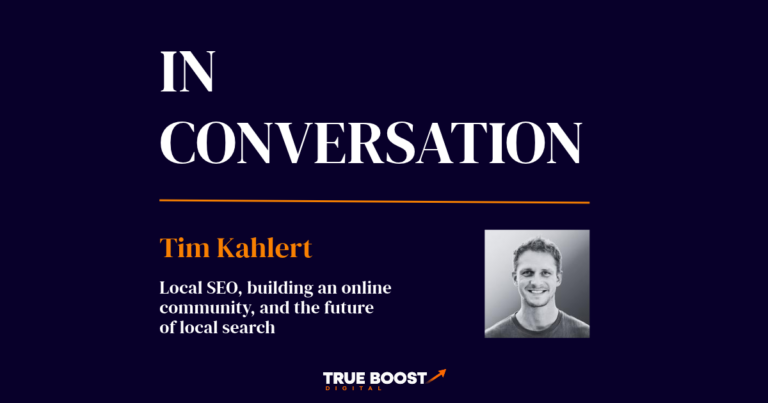
Welcome to this installment of In Conversation from True Boost Digital. In this series, I’m speaking to marketers, founders and business owners about their stories – how they got started in their field, what motivated them to pursue their chosen path, and the successes and challenges they’ve experienced along the way. My hope is that we can learn the lessons about what worked – and perhaps what didn’t – and gain their perspectives on some of today’s biggest marketing topics.
For this conversation, I sat down with Tim Kahlert. Tim is a renowned local SEO and Google Business Profile expert; he is CEO of Hypetrix, an agency specializing in local SEO. In addition, Tim is also widely known in SEO circles as the creator of one of the largest Facebook groups dedicated to local SEO, with over 120,000 members. Tim’s free Local SEO Bible is an excellent starting point for any business interested in expanding local visibility.
I’d like to thank Tim for taking the time to share his story and provide his valuable insights, and make sure to follow him on Facebook or LinkedIn for essential local SEO tips.
You can listen to the conversation using the Spotify player below, or read through to the article underneath.
How did Tim get started in online marketing?
Tim Kahlert’s journey in the world of digital marketing started back in 2015, and to begin with, it was anything but straightforward.
Tim had studied business communication at university in Berlin for three years, but felt that he didn’t learn anything practical throughout his studies. He decided to go to Australia with the intention of returning to start his own business, and while he was there, he searched for ‘how to make money online’. The result of his search was learning about Google Ads – initially through affiliate products.
“The return [on the affiliate products] was zero,” explains Tim. “But the learning curve was steep, so I learned a lot in that time. And then, I was like, ‘Okay, I need to get better – and I need to actually get clients.’ And then I was thinking, ‘How do I get clients?’
“So after a couple of weeks, I realized people give you more money when they receive some value from you. So, I went to Facebook groups, and searched for people’s questions in certain Google Ads groups. And this was my plan to get more clients, or even to get my first client eventually. And so, I basically started answering people’s questions in Facebook groups.
“I had been doing this for 14 hours a day for two weeks. And within those two weeks, my bank account shrank so fast. I had $5 left in my pocket. I was living in this van, having to decide between petrol or food. I was sweating. I couldn’t sleep. It was a really rough time.”
Thankfully for Tim, his first client was just around the corner.
“It was funny when he reached out first,” says Tim. “This guy, I think he was from Michigan. He had a towing service. He was telling me, ‘I need someone who can help me with my towing service marketing.’ It was so ridiculous, my answer, because this is exactly what I wanted – and then I pushed him away. I said, ‘I’ve never given coaching to anyone. I can’t help you.’ And then he said, ‘I don’t need anyone to give me coaching. I need someone who can do a good job at my business.’
“So, one or two days later, he transferred me $600, and I just applied simple Google Ads strategies to his account. It was super easy to get him leads, because a towing business doesn’t really need a website; they just need calls. And the audience of a towing business doesn’t really need more information when they’re on the side of the road.
“This is how everything started.”
What led to the creation of Tim’s Facebook group?
These days, Tim is perhaps best known for the Facebook group he started in 2019, which provides a forum for discussions of local SEO tips and strategies. The group has continued to grow in recent years, and now boasts over 120,000 members.
I asked Tim about the catalyst for creating the Facebook group in the first place.
“So, I kept doing the answers in Facebook groups to just eventually get a second client,” explains Tim. “That towing service guy, he wanted me to take over the SEO eventually, and that’s how I got into SEO. I started posting case studies in other SEO groups because I didn’t have my own group. Eventually, those admins banned me from those groups for literally not pitching anything. All the posts that I created were just case studies with zero links, zero calls to action. I think I got banned from three groups! Two of them literally said in their [group] description, ‘If you want to post case studies, please do it.’ As soon as I did it, they just banned me.
“I was like, now I’m just stripped of my only way to get clients. I had to find a solution for that and created my own Facebook group.”
As is the case with many things in the online marketing space, success didn’t come overnight for Tim or his new Facebook group.
“I really had a monologue for six months. I was posting every day and nobody was listening. Nobody read it. Nobody commented. Nobody replied. It was frustrating. You just have this monologue with yourself for 180 days or more until a little bit of traction comes up, and people start to reply to you. People join the group. In the first year it grew to around 900 people. Then in the second year, it grew to 30,000 people. So, as you can see, the beginning is always very hard, and then it kind of has exponential growth until it reaches a peak at some point.”
I asked Tim about the challenges that have accompanied the growth of the group, particularly given its size nowadays.
“I’m not sure if there is a difference between [managing] a group that has, let’s say, 20,000 members or 120,000 members. You will only reach a certain number of people anyway. When I look at the data from the last six or seven years, you can see the maximum amount of people who were engaging on a daily basis was 10,000 to 15,000. Then, on a monthly basis, this might change a little bit – now I can see like there’s more or less 60,000 people engaging on a monthly basis, which is half the group. Obviously this is impossible when your group is only 20,000 members.
“What I found [in terms of challenges] is you will eventually come to a point where you have to ban people, or you have to restrict people’s reach or delete certain posts, or just do something that some people wouldn’t necessarily like. They think they can use your group reach as an advantage basically to publish their content.
“From my perspective, I never wanted to act like a dictator. I never banned people who disagreed with me. I never banned anyone who was constantly disagreeing with me. But I certainly banned people who were just disrespectful and destructive in their intent. I don’t want to have to deal with this on a daily basis, so I banned those people. But I never banned anyone who was just disagreeing with my approach, and I think it’s important to have or to live some kind of democracy in the group. But my point of view was always the user experience. What do the majority of users experience in the group? That’s what I base my decisions on.”
Get practical perspectives on SEO, AI and the digital marketing decisions businesses are wrestling with, delivered to your inbox.
The transition from Google Ads to local SEO
Tim previously explained that his start in the world of digital marketing came via Google Ads, yet now he is known as an expert in local SEO and Google Business Profiles. I asked what influenced this decision.
“I think it has to do with my poker background, because in order to be a good player, you need to be very patient. In poker, it can take so much time to actually beat variance, and it’s very similar to what SEO is. You need a lot of time to beat the variance. You have these daily ups and downs, these weekly swings and maybe even monthly fluctuations. That’s where my strength is, and that’s where I can actually compete, where I actually know that this is not something I’m going to give up very soon. Everyone wants shortcuts, but usually they come with a cost.
“Another point was that Google Ads was a little boring, to be honest. It was always the same, especially if there was no website work involved – you would just create the ad, check the data, and you would always do this. I was never really someone who enjoyed data that much. You have to use it for SEO, which is alright, and it makes a lot of sense. But Google Ads was almost all only data.
“I also saw the opportunities that came with SEO because it’s much more creative work as well. You can create great websites and track the conversions on those websites, and also make design changes and things like that. While in Google Ads, especially for very urgent services or service businesses, a website is not really necessary. You could create a landing page for, I don’t know, a roofing company – but apart from that landing page, nothing else needs to be done. You just send people to that landing page, and that’s it. But in SEO, you have so many other opportunities to create content. And I have always enjoyed creating content since I started with the Facebook group.”
Local SEO questions and Google Business Profile tips
Tim is someone who is heavily involved in local SEO on a daily basis, so it was only natural to gain some valuable insights on some of the pertinent topics in this sector.
The most common questions Tim receives about local SEO
“The most common ones are very broad questions about the ranking factors – what I believe is moving the needle, or Google Business Profile ranking factors. I think those are the biggest questions. Seeking very general advice on how to quickly boost the performance of a Google profile or your local SEO.”
What is the biggest misconception in local SEO today?
“That your Google Business Profile posts increase your rankings and performance.
“I think this is what many agencies build their entire SEO strategy around, because the client sees it. We can see it on our own clients’ profiles, right? If you miss a post, you get an email the next day: ‘Hey, you’re not working on my profile anymore,’ right?
“So the Google posts stand for work on the profile, which is ridiculous, but this is how it is portrayed in the whole local SEO industry – and I think this is the biggest misconception. The posts are great, but they’re not prominently placed on a Google Business Profile. They’re a conversion factor at most.”
Advice for someone wanting to start a local SEO agency
“My advice for someone who just wants to start with local SEO would be to really niche down. Just focus on, for example, only auto repairs, only lawyers, or only roofers. Create your agency website around those very hyper-niche topics because that will guarantee you more money and more business in the long run, right? For everyone who’s starting out, I think this is a great way to separate yourself and differentiate from the majority of people.”
One thing that businesses could do immediately to help their local visibility
“Getting reviews on a regular basis. And I guess I’m not telling anyone anything new when I say that, but review recency is certainly a ranking factor. Google determines your ranking positions based on how fresh your reviews are, and if your competitors’ reviews are fresher than yours, then they will get ranking benefits and they will get more exposure and visibility from Google.
“What is really nice to develop is a strategy on how to get those reviews and also have those reviews include the right content. I think that’s what people miss, because we’re heading towards very sophisticated online marketing with AI. In this particular case about the reviews and collecting reviews, we realize that reviews are affecting how AI mentions your business, how AI talks about your business, and how AI cites your business.
“If you know the perfect moment to ask for a review, you will get exactly what you want the reviewer to talk about your business in that particular review. I’ll give an example. There was a hair transplant clinic, and whenever you searched for a nice hair transplant clinic, they wouldn’t show up. If you searched for the most obvious search terms or sentences, they wouldn’t show up. But when you searched for who has the nicest personnel in a hair transplant clinic, they would suddenly show up because all their reviews were about ‘the employees are nice’, ‘the coffee was nice’, and ‘the facility was nice’, but nothing about the results. Nobody actually talked about the results.
“So I was like, ‘Look, you have a huge problem with the content of your reviews, because everyone is talking about the coffee but not about the results.’ That is not because you’re doing a bad job. It’s because you’re asking at the wrong moment.
“As a clinic in particular, you can frame it as some kind of medical necessity to ask about the process, right? So you would send them another follow-up email three months later, then another one four or five months later. And then, when everything is healed, you send them another one eight months later and tell them, ‘Look, come over to the clinic. I want to look at how everything looks and check that everything is going well.’ And then, at that moment, you show them a before-and-after picture, basically, and you ask them for the review. That actually made it possible that they would start to collect reviews that are actually meaningful.
“When you want to apply that to every business, it’s basically just asking the customer at peak satisfaction, right? When the customer is most happy about whatever you did for them, that’s the moment you should ask, ideally – and align that with the content you want to have in your reviews.
“Also, I think if you’re not getting any reviews at all, it’s better to get some reviews, no matter the satisfaction level – just to make that clear. I think what I mentioned [the hair transplant clinic strategy] is a more advanced tactic for businesses or marketing agencies who are already able to get reviews. They can build on that and actually have people say certain things about the business that you want to be known for on the Internet.”
AI and the future of local search
As the usage of AI and LLMs in digital marketing becomes more prevalent, there is the potential for this to have an impact on the local SEO ecosystem. I asked Tim if he thought there would be a significant shift over the next couple of years, or if he thinks the situation will remain relatively static.
“I think it’s very hard to break habits,” says Tim. “People have been using Google for 20-30 years, and people who have used Google will keep using Google. The AI Overviews are already their best search result. Obviously, there’s room for improvement. You can probably turn this into AI Google listings at some point or completely change the UX of how these AI Overviews are presented.
“But I think Google will always be the dominant force when it comes to AI search, even if people are using ChatGPT. I’ve seen a statistic today that Google still gets 70 times more search queries or search requests than ChatGPT. It’s not really a question about transitioning to something entirely different. I think people will stick to Google because that’s what they’ve always done and where they think they get the best reliable answers from. And, as I said, it’s very hard to break habits.
“Certain users are going to ChatGPT, but at the same time, this diversification is already happening, and has been happening for several years. My girlfriend, for example, I asked her, ‘Look, can you just show me how you find a nail salon?’ And I was expecting her to open Google and search for ‘nail salon.’ What she did was she opened Instagram and searched for a nail salon. I was like, ‘Are you… Why?’ I was so sure, now I can tell her something about Google, and she opened Instagram. I was like, ‘Wow.’
“So it’s already been happening for a very long time. This diversification is not only ChatGPT or Google. It’s also Instagram, and people are searching on Facebook, and younger generations are searching on TikTok. So in terms of AI, probably these other networks will eventually pick up on it and create their own AI experience if people want to search for something. The experiences are very personalized for people who just have different search behaviors, and I think this might play a role, so that you have to optimize your business presence to show up everywhere.
“But eventually, the factors for showing up somewhere can’t be that different, right? It’s always trust-related, and you need expertise, experience, authority to create that trust. I don’t think we will shift away from that. I think it’s just more diverse in terms of search behavior, and it’s very hard to see it black and white, either Google or ChatGPT, because it’s a very grey area, and very nuanced.”
What lies ahead for Tim and Hypetrix?
To wrap up our discussion, I asked Tim what plans lay in store for the upcoming twelve months.
“Ever since I started this business, I started with affiliate marketing, what I told you at the beginning. I was sure I would build my own brand and then eventually sell an online course, because that’s probably the most traditional way of how you make money when you start from nothing. You can also start with a marketing agency because it doesn’t require you to invest anything upfront if you’re working with upfront payments.
“But, I never actually pulled through on the online course. A few years ago, I was creating a Google Business Profile course, and it was almost done. It didn’t need much, but something inside of me was holding me back, and I can’t really explain what it was, but I never finished it. I never actually published it, and it’s still sitting on my Google Drive, a little bit outdated and dusty.
“But I started a new attempt, and this time I’m way more motivated and way more inclined to do it. The first part is about local landing pages right now, and it’s hopefully going to be published in the beginning of December. I have so many modules already ready, but they’re still missing thing, so I just want to publish it gradually. So in 12 months, I will hopefully have the whole course ready, at least in 12 months, but I’m aiming for four months or something like that.
“So that’s probably a big shift in my own business. I think that I was trying to help more people in the last seven years, and that it is the most logical step for me to create a course and to actually explain things in more detail, because that’s what I think people expect from me.
“Plus, most people, because of AI, think courses are dead, and I just want to disprove everyone and tell everyone, ‘Look, courses are certainly not dead.’ I don’t believe courses are dead, especially because AI is hallucinating and not telling the truth. But also because it would still take people ages, when they’re not local SEO experts, to get all the information you’ve gathered over the last several years. They don’t know the answers they don’t know – their unconscious incompetence is so big that they just don’t know what they don’t yet know. And getting through all these stages – conscious incompetence, conscious competence, and unconscious competence, is a journey. And it takes time. It’s not just done by opening Claude and asking some questions.”
My thanks again to Tim for taking the time to be a part of In Conversation.
You can learn more about Tim and his work at the following links:
Facebook Group: Local SEO Strategies & Google Business Profile Help with Tim Kahlert
ABOUT THE AUTHOR
